By Brenton Boyd
In Black Magic: Religion and the African American Conjuring Tradition, Yvonne Chireau spins a web between the blues, the erotic, and Conjure that lingers on the skin of those who pass through it. For Chireau, the blues would be incomplete without allusions to the messiness, the longing, and even the sex brought forth through acts of magic. Conjure was “the supernatural force” behind Blind Lemon Jefferson’s lover’s charms, behind the “frustrated paramours who wielded gopher dust or High John the Conqueror Root in their pursuit” of intimate satisfaction (147). To sing the blues in the key of love was to sing of alchemical experiments in a star-crossed sexual life—one doomed from the start by state-sponsored antiblack violence, at most, and human nature, at least. Although the gender and sexual fluidity of many blues singers has been thoroughly explored in academic literature, scholars have focused on the cis-heterosexual context when drawing connections between matters of the heart and Conjure-inspired blues.[1] When we exchange this lens for a black queer and trans one, however, new insights come to the fore. And sometimes, they will appear through movie magic.
Producers at Warner Brothers Studio invited Yvonne Chireau to serve as a consultant on the set of Ryan Coogler’s 2025 film Sinners. Part vampire horror, part historical drama, part musical ensemble, Sinners follows twins Stack and Smoke’s prodigal return to Clarksdale, Mississippi, where they invest dirty money from Chicago into an old sawmill with the intent of opening a juke joint. Emerging in the early twentieth-century South, juke joints were small blues clubs (or even houses) where African Americans reveled in their most excessive and joyous manner. They were highly sensory spaces: the smell of fried catfish, the sound of blues instruments and laughter, the feeling of sweaty dancers rubbing against you, the taste of a lover’s lips. The term “juke” also signifies physical action (as in “to juke” or boogie with high energy) and social action (as in to deceive or trick in African American Vernacular English). This latter denotation aligns with key terminology in Hoodoo, whereby “to trick” is to perform a spiritual operation on someone with malicious intent. Put together, a juke joint is a space where black dancing and magical acts transpire.
Chireau writes in Black Magic that juke joints were necessary for the endurance of Hoodoo in that “clubs gave expression to diverse new cultural forms [and ensured] the survival of supernatural practices” (139). Smoke and Stack—representing a certain dualism that Hoodoo practitioners might link to right- and left-hand (or conventional and unconventional) rootwork—inadvertently conjure a space for the celebration of such forms. Ironically, this space also attracts the likes of white vampires and Ku Klux Klan members, the Grand Dragon of which sold the dilapidated sawmill with ulterior motives. This is not a novel storyline, however, for black and queer audiences. History proves that our sites of joy are frequently turned into sites of violent spectacle. Many since the film’s release have noted the element of cultural appropriation in the failed ploy of the Irish vampire leader, Rennick, to arrogate black musical skill through his sanguivorous powers.[2] But with a black queer eye attuned to the history of Conjure, we might perceive another layer. Perhaps what went down at the juke joint was truly an expression of what Kara Keeling calls “queer temporality.” If ritual is “an orchestration—an ordering of time and space, and in each instance, a manifestation of aesthetics” (Daniels 400), then queer temporality in Sinners wields the blues scene to orchestrate rituals characterized by an aesthetics of excess. This is to say that what Rennick and the Ku Klux Klan seek to undermine cannot be captured within a single point in time or space. The juke joint attendees’ 1930s Mississippi blackness was slippery, supernatural, incompossible. Keeling would say that it “names the dimension of the unpredictable and the unknowable in time that governs errant, eccentric, promiscuous, and unexpected organizations of social life” (19). Conjuring (with) the blues empowers Sinners to queerly tap into that dimension.
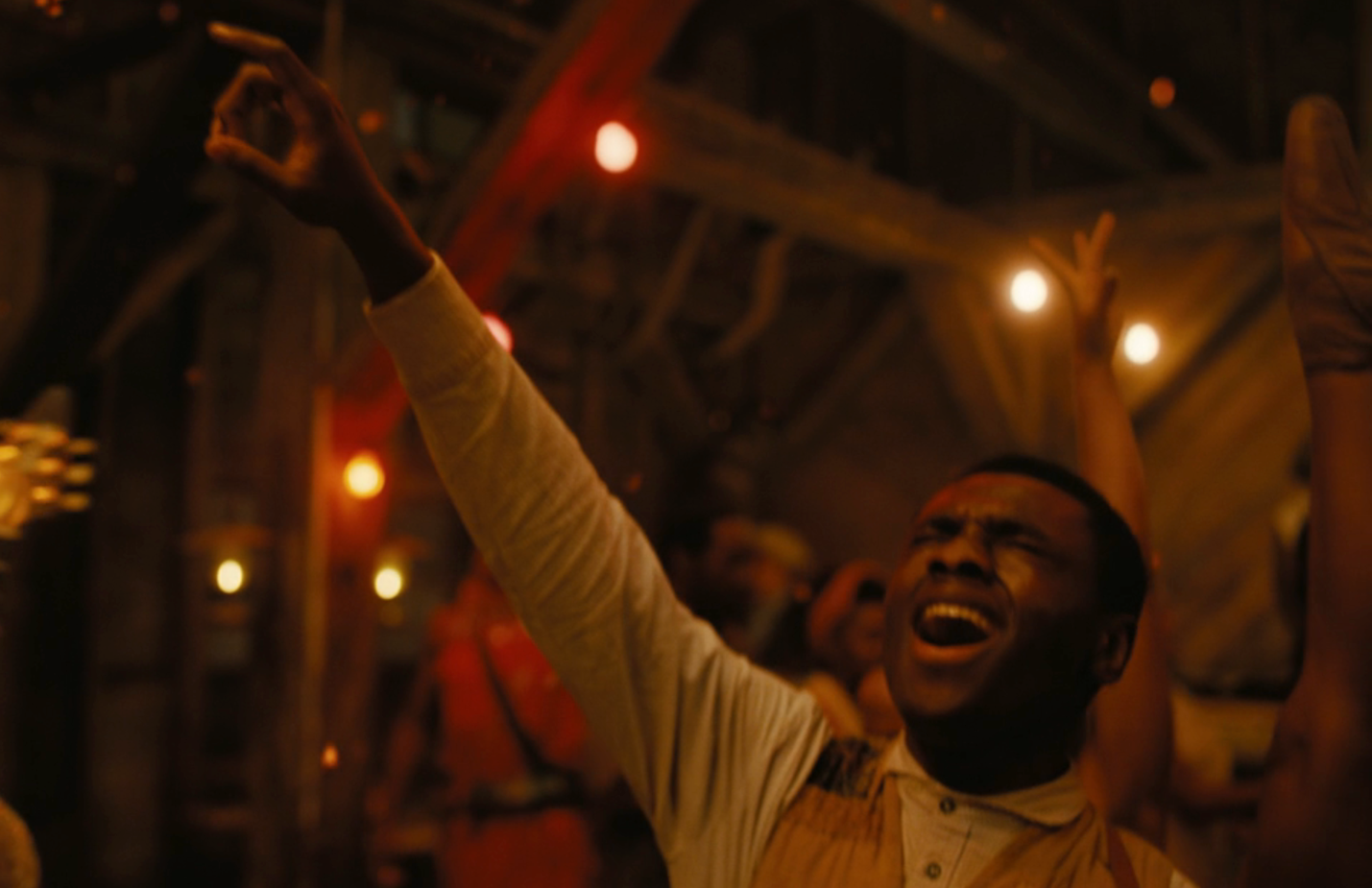
During Preacher Boy’s time-bending performance of “Somebody Take Me,” we can hear Annie—the conjure woman and spiritual nexus of Sinners performed by Wumni Mosaku—speak over a momentary diminuendo: “There are legends of people born with the gift of making music so true, it can pierce the veil between life and death, conjuring spirits from the past and future” (Figure 1). I want to ask in light of Annie’s testimony: What happens when we reimagine black spiritual and sexual excess as the sound of “making music so true” that it violates what has been deemed reality? What if the process and not the product of our sexual-spiritual endeavors can pierce the veil between life and death? In this sonic rupture, the juke joint ceases to be a mere physical location and instead becomes an auditory threshold where black realities previously deemed impossible are most vividly articulated.
While there are no characters explicitly labeled as queer or trans in Sinners, I would argue that the spiritual praxes embedded in the juke joint—as a space of sacred and secular performance—are themselves queered by the incompossibility of black sexual life. As seventeenth-century polymath Gottfried von Leibniz used the term to designate the fundamental exclusion or negation of concepts from a given metaphysical system or world, I appropriate incompossibility to describe the presence of a twisted form of excess that often passes for life in the valley of the shadow of slavery, Jim Crow, and beyond. Sinners delivers moving images and sounds to help us explain the intervention that Conjure provides as a force of literal magic into the voids left by this world. This is not purely abstract or what Yvonne Chireau calls in a recent interview about the film, the “voodoo ooga booga” (“‘I Don’t Do Horror’”). Rather, like Conjure, what is twisted and incompossible about black sexual life is its ability to jump out of nowhere. Shouts, charms, and jukes attest to material histories of pain and pleasure, healing and harming in spite of a fundamental exclusion from what is possible, let alone permissible.
Black life is an experiment in joyous and even contradictory performance without the coordinates necessary for a stable deposition into a set category—whether metaphysical or sexual. The brilliance of Sinners partially lies in its appeal to audiovisual and temporal process instead of linear product to such an extent that even the narrative flows of the main characters are queered. And that queerness is framed by the larger story of the wrath of Jim Crow. The first camera shot after the two-hour and eighteen-minute-long piece’s opening title card is of the sun rising early in the morning over a poor black community in the Mississippi Delta. Most of its residents appear to be attending church—a daylong respite from the inhumane sharecropping system—while Preacher Boy drives to his father’s church after a night of debauchery. We later learn that Preacher Boy, otherwise known as Sammie, the younger cousin of Smoke and Stack, was given a foreshadowing warning by his father: “If you keep dancing with the devil, one day he’s gonna follow you home.” Moments later, Smoke and Stack also tell Preacher Boy that they returned to Clarksdale because they would rather “deal with the devil they know” than the one they do not in Chicago. Jim Crow—the name given to an era of legally and socially-encoded racial violence after Reconstruction—itself comes from a dancing devil of sorts: the minstrel character popularized by Thomas D. Rice in the nineteenth century.
Minstrels, irrespective of their comical actions, were monstrous in appearance and questionable in moral character. Feeding into this logic, the black performing body was also a source of fear. Countless attempts to police or outright ban black religious gatherings appear in the archive of slavery, such as South Carolina’s Negro Act of 1740, which prohibited the keeping of “drums, horns, or other loud instruments, which may call together, or give sign or notice to one another of their wicked designs and purposes” (397). The juke joint and the blurring of the sacred and the secular therein emerge in defiance of such religious histories. When Stack rallies from death after having been bitten by Mary, his mixed-race paramour, Smoke asks if it is really him making noise in the room where his corpse was locked. Stack answers, “Nah, fool, it’s Jim Crow.” By sarcastically identifying his supernatural resurrection with the antiblack world, Stack frames his very existence as a transgressive performance that blurs the line between a hallowed miracle and a secular blues rhythm. In this moment, their dialogue suggests that the black body in performance—whether through rootwork or the riff of a guitar—is a fundamental transgression that refuses to remain buried by the laws meant to silence it. Sinners draws overt connections between sin (as a quality and habit), sexuality, antiblackness, incompossibility, and the supernatural.
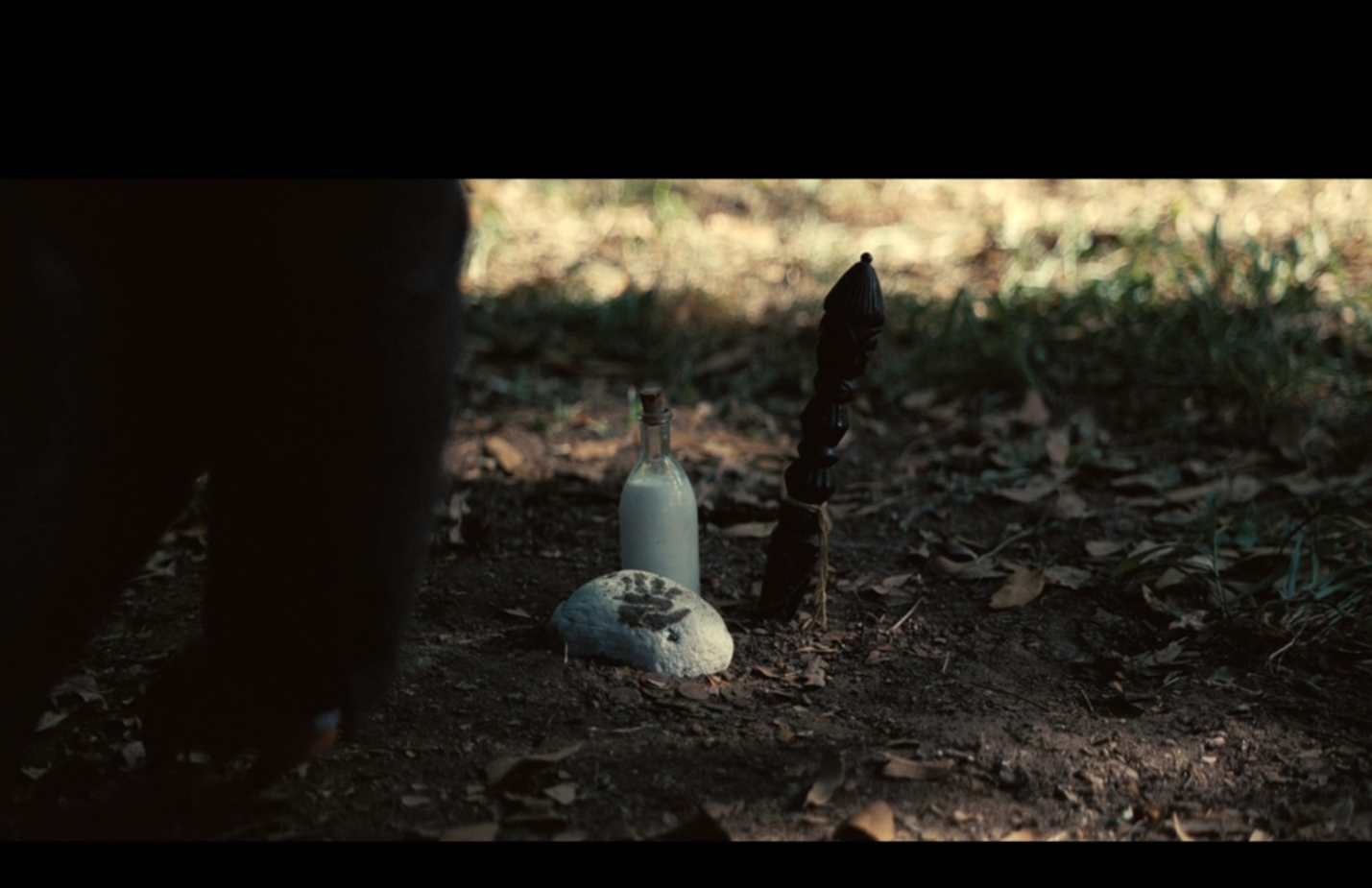
Yvonne Chireau’s presence is particularly palpable in the character of Annie, who straddles life and death in conjurational practice and family ties. Again, while Ryan Coogler and his production team were not likely thinking in black queer theoretical terms, there is something unabashedly “quare” (to borrow E. Patrick Johnson’s Southern-inflected vocabulary for non-normative black sexualities) about this conjure woman. When we first encounter Annie, Smoke is kneeling over the grave of a small child outside of her cabin. Haitian Vodou and US Southern Conjure symbolism, including vèvès, magical aphorisms, and materia magica, adorns the windows and walls of her home. “Papa’s here,” Smoke intones while placing a small bouquet of flowers next to a rock with a small black handprint, a bottle of milk, and a small hand-carved wooden African sculpture (Figure 2). The presence of these objects in place of a traditional gravestone speaks to historical African American burial practices, as well as the grave-tending and altar-building endemic to Conjure. Smoke’s declaration as “papa” also coincides with the mother and father motif recurring throughout African American and Caribbean magico-religious traditions. Annie—whom we later discover is the mother of the deceased—steps from her cabin with queerly poignant words on her lips: “No misery is worth complaining about.” Their conversation is pregnant with the same tension we would expect from the strained reunion of a former couple after a breakup.
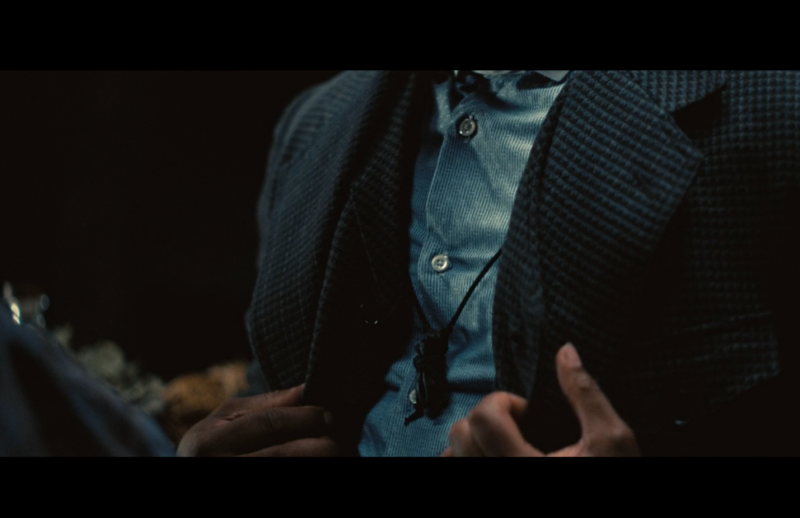
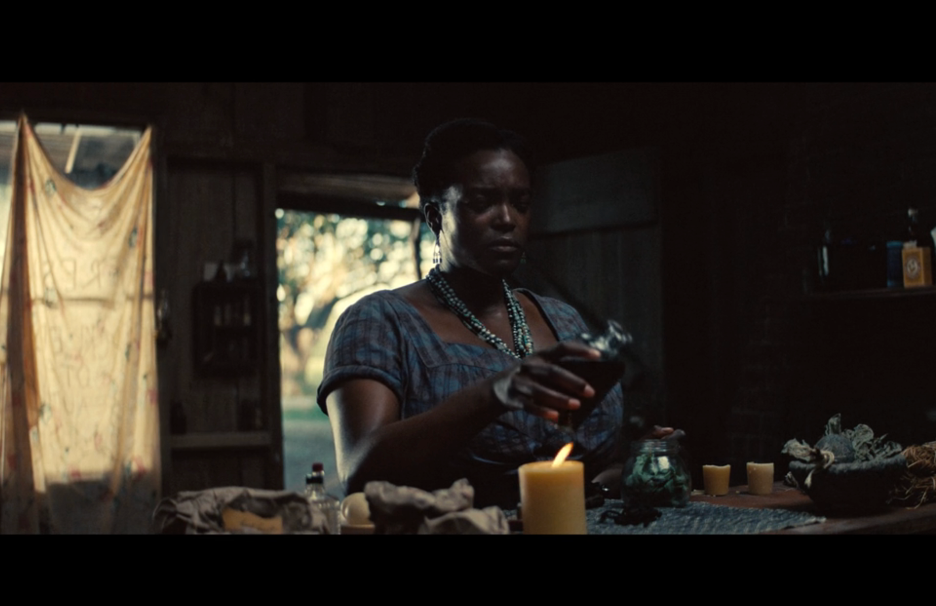
While I am not prepared to argue that these things in and of themselves make Smoke and Annie a queer couple, the dual appearance of Annie’s queered spiritual practice and the steps taken after the grave scene bring queerness to mind. The flow of their graveside conversation is briefly interrupted by a local child who patronizes Annie’s in-house botanica for a pinch of High John the Conqueror Root powder. This is perhaps the most well-known type of materia magica in Conjure with uses ranging from healing and harming others to luck and protection. When the young customer leaves, Smoke begins to question the financial and practical implications of Annie’s spiritual services. Annie responds, in a moment of post-production engineering whereby a continuous low-frequency sound (or drone) is played softly in the background to achieve an otherworldly and dark atmosphere: “How you know I ain’t pray and work every root my grandmama taught me to keep you and that crazy brother of yours safe, everyday since you been gone?” I think the soundscape here queers Annie’s magic and her very voice. She is given a deeper, darker tone—one broken only by the question, “Why them roots ain’t work on our baby then?” The drone subsides and is replaced by an eerie silence. “But they work for you,” Annie replies. She then takes the mojo bag—a talisman in Hoodoo that serves different purposes depending on its content—from around Smoke’s neck, feeds it smoke and liquor, and prays. Sound, here, is not the blues themselves but rather a cinematic excess that orchestrates the most intimate of rituals. It also allows Annie to blur the lines between feminine and masculine, fertile and barren (Figure 3).
With one foot in the world of the living and another in the world of the dead (as a conjure woman and mother to a dead child), Annie’s queerness is transitive and transgressive. For black trans theorist C. Riley Snorton, transness—and to a certain extent queerness—is the “central engine or the matter of change.” To transition is to fundamentally change the state of something or, in African American Vernacular English, to pass away. Annie is an agent of transitivity in her ability to alter probabilities through Conjure and in her close connection with death. This transitivity serves the entire cast well in their later dealings with the supernatural threat of vampires. Learning with and through life’s endings—or bottoms—is Annie’s forte. When the reunited couple begin to have sex after charging Smoke’s mojo bag, Annie is penetrated from behind. Their sex—like the juke joint—is messy, passionate, excessive. Or perhaps like smoke’s character and substance, black sexual life revels in this incompossible power to appear and disappear out of nowhere.
Works Cited
Anderson, Jeffrey E. Conjure in African American Society. Louisiana State UP, 2005.
Chireau, Yvonne P. Black Magic: Religion and the African American Conjuring Tradition. U of California P, 2003.
—. “‘I Don’t Do Horror, Ryan Coogler’—Black Magic’s Dr. Yvonne Chireau on Sinners and Bringing Hoodoo to Life.” Interview by Megan Goodwin. Religion Dispatches, Political Research Associates, 24 Apr. 2025, religiondispatches.org/i-dont-do-horror-ryan-coogler-black-magics-dr-yvonne-chireau-on-sinners-and-bringing-hoodoo-to-life.
Coogler, Ryan, director. Sinners. Proximity Media, 2025.
D’Agostino, Anthony Michael. “Mouths & Mirrors in Ryan Coogler’s Sinners.” Film Quarterly, vol. 79, no. 2, Winter 2025, pp. 7–14.
Daniels, Kyrah Malika. “Ritual.” Encyclopedia of Aesthetics, edited by Michael Kelly, 2nd ed., Oxford UP, 2014, pp. 400–4.
Davis, Angela Y. “I Used to Be Your Sweet Mama: Ideology, Sexuality and Domesticity in the Blues of Gertrude ‘Ma’ Rainey and Bessie Smith.” Sexy Bodies, edited by Elizabeth Grosz and Elspeth Probyn, Routledge, 2013, pp. 231–65.
Dromgoole, Ambre, and Ahmad Greene-Hayes. “Sinners: White Violence, the Spirit(s), and the Purifying Fire of the Blues: A Conversation Between Ahmad Greene-Hayes and Ambre Dromgoole.” Ecumenica, vol. 18, no. 2, Nov. 2025, pp. 178–95.
Finn, Julio. The Bluesman: The Musical Heritage of Black Men and Women in the Americas. Interlink, 1986.
Johnson, E. Patrick. “‘Quare’ Studies, or (Almost) Everything I Know about Queer Studies I Learned from My Grandmother.” Text and Performance Quarterly, vol. 21, no. 1, 2001, pp. 1–25.
Keeling, Kara. Queer Times, Black Futures. New York UP, 2019.
Sinners. Directed by Ryan Coogler, performances by Michael B. Jordan, Hailee Steinfeld, Miles Caton, Jack O’Connell, and Wunmi Mosaku, Warner Brothers, 2025.
South Carolina. “An Act for the Better Ordering and Governing Negroes and Other Slaves in This Province.” The Statutes at Large of South Carolina, vol. 7, edited by David J. McCord, A. S. Johnston, 1840, pp. 397–413.
Snorton, C. Riley. “Survival Is a Relational Praxis.” Interview by Noura mutima Brock-Jaber. Mosaic Literary Magazine, Literary Freedom Project, 17 Jan. 2024, mosaicmagazine.org/c-riley-snorton-interview.
Stewart, Lindsey. “Work the Root: Black Feminism, Hoodoo Love Rituals, and Practices of Freedom.” Hypatia, vol. 32, no. 1, Winter 2017, pp. 103–18.
[1] See also Angela Y. Davis, “I Used to Be Your Sweet Mama” (1995); Lindsey Stewart, “Work the Root” (2020); Julio Finn, The Bluesman (1986); and Jeffrey Anderson, Conjure in African American Society (2005).
[2] Anthony Michael D’Agostino’s recent Film Quarterly article “Mouths & Mirrors in Ryan Coogler’s Sinners” argues that the film both critiques and reclaims artistic appropriation. Similarly, Ambre Dromgoole and Ahmad Greene-Hayes briefly discuss “white supremacist cultural appropriation and extraction” (178) in their analysis of Sinners.
Brenton Boyd is an Assistant Professor and Director of the Program in Black Studies at the University of Tampa, where their scholarship navigates the intersections of Black queer and trans feminist ecologies, cybercultures, and performances of the sacred. Their work is particularly attentive to the role of cinema and new media—including experimental, multisensory, and augmented reality art—as a site for theorizing Black femme embodiment amidst ongoing environmental catastrophes. Boyd’s research has been featured in prominent venues such as liquid blackness, Duke University Press, Syndicate Theology, and ZOE: Journal of Social Transformation. Also an anti-disciplinary artist and rootworker, their creative practice blends ritual, improvisation, and emerging technologies to map the queer dimensions of living in the Caribbean and US South.