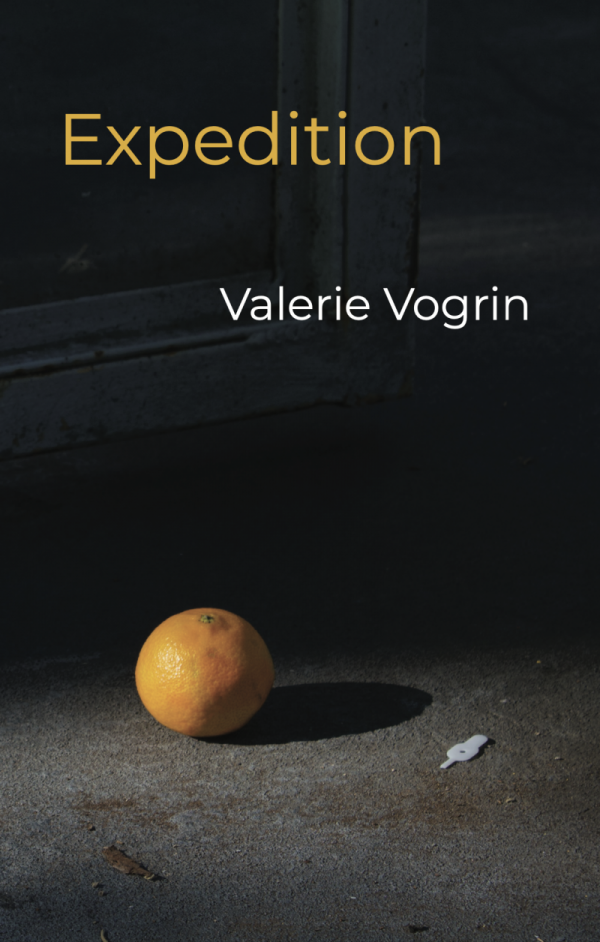
The Press’s latest release, Expedition by Valerie Vogrin, is currently available on our website. In this interview, Vogrin offers insight into her creative decisions and identifies thematic connections between her past and present fiction. The following interview was conducted via email.
Anika Schmid: What can you tell us about the trajectory of your fiction? In that context, what does Expedition represent?
Valerie Vogrin: Much of my fiction has been concerned with the ways that people inhabit and negotiate space. Over the course of my first novel, Shebang, the protagonist Fin Sweetleaf gradually loses a territorial dispute with her nephew Hector over the control of their shared home’s lovely and spacious front porch. Meanwhile, with or without Fin’s assent, the house begins to fill with people in need of a home—friends of Hector’s, friends of friends, and even Hector’s long-lost father—people who come to be hers and Hector’s found family.
It’s almost embarrassing that I didn’t recognize, until considering this question, the clear thematic connection between Shebang and Expedition. In this book, however, the protagonist Margo Webster is the (sort-of) uninvited guest, the character in search of a home.
Expedition also represents a decades-long process I refer to as “breaking up with realism.” Although it’s firmly grounded in domestic life—the odd sounds, smells, and vibrations experienced by a person living in a basement apartment—I introduced slipstream elements to defamiliarize and refresh the trope of “starting over in a small town.”
AS: Your novella offers readers a view of the world through the eyes of a 52-year-old woman. What does it mean to you to write a protagonist of this age?
VV: A few years ago, I realized that although I had gotten older, my protagonists hadn’t. I am in my sixties; very few of them are over the age of forty. I shudder to think that I have inadvertently contributed to the perpetuation of the idea of the “invisible older woman” by not writing about characters closer to my own age. Though I first conceived of Margo as a woman in her thirties, I found it very satisfying and engaging to reimagine her bewildering experiences after aging her by twenty years.
I’ve observed that short stories and novels portraying older female characters often center on conflicts with their grown children, a significant loss, such as the death of a spouse, or a dire medical diagnosis. The narrative structure of this fiction frequently involves an interweaving of past and present as the protagonists reflect on prior events. While it’s natural for those of us who’ve passed the half-century mark to reflect on bygone days, I want to write fiction in which the primary narrative motor isn’t reminiscence. Rather diabolically, I enforced this in writing Expedition by giving Margo extreme retrograde amnesia.
AS: Author Jamey Bradbury describes Expedition as “a story about the strength and affirmation of female friendships.” How does your writing explore these bonds between women?
VV: The grandparents who raised Margo are dead. She’s been estranged from her missionary parents for most of her life. With almost no recollection of what her teen and adult life were like—no memories of specific friends, mentors, or lovers—she’s literally starting from scratch.
Margo aimlessly follows a non-serious boyfriend to his childhood home. When he runs off, she’s more unmoored than ever, yet this turns out to be a piece of good fortune as Margo develops relationships with his sister, mother, and grandmother—who have been similarly unmoored by the imprisonment of their father, husband, and son, respectively. I’m fascinated by the way bonds can be quickly formed through the magic of propinquity—people thrown together—and empathy.
Although Margo initially appears to be the character in need of rescuing, I wanted to make clear that these women, individually and as a group, are saving each other.
AS: What do you hope readers will take away from Margo’s journey?
VV: Usually, no matter how intimate the voice or how long the tale, a considerable amount of a first-person narrator’s life remains unknown to the reader. Expedition works differently. The reader comes to know early on the whole of what Margo knows, thus they occupy similar positions, trying to make sense of her circumstances with incomplete knowledge. I hope readers will find this to be an engaging experience and that they’ll linger in the fictional world imagining Margo’s possible futures. Perhaps readers will also be inspired to reconsider, as I have, our sometimes-fierce allegiance to our planned trajectories, despite our awareness of how easily and unexpectedly we may be thrown off course.

Valerie Vogrin’s collection Things We’ll Need for the Coming Difficulties was awarded the Spokane Prize for Short Fiction (Willow Springs Press, 2020). She is the author of the novel Shebang, and her short stories have appeared in journals such as Ploughshares, AGNI, Hobart, Memorious, Zone 3, and The Los Angeles Review as well asin 2011 Pushcart Prize XXXV: Best of the Small Presses, The Best Small Fictions 2015, and New Stories from the Midwest 2020. Her work has been supported by residencies at the Virginia Center for the Creative Arts and the Anderson Center for Interdisciplinary Studies. Valerie received her MFA from the University of Alabama. She’s a professor of creative writing at Southern Illinois University Edwardsville. She lives with her husband, dog, and cat on a tiny unnamed lake in Moro, Illinois.
Anika Schmid is a graduate from the University of Tampa with a Bachelor of Arts in Writing. She was involved in the production of various publications as an editorial assistant for the University of Tampa Press, editor-in-chief of Q: Journal of Undergraduate Research & Inquiry, and head copy editor of The Minaret newspaper. She spends her free time expanding her album collection and brainstorming ideas for her next story. Visit her writing and editing portfolio for more information.