By Michael Dunn
On Manchester-based, American singer/songwriter BC Camplight’s latest album “A Sober Conversation,” (2025) which straddles the realms of conversational poetry and melodic instrumentation, the lyrics “who can think about time at a time like this” really stand out. Time is, as Shakespeare so aptly noted, most definitely out of joint; perhaps, more so now than ever before. Walter Benjamin, too, clearly understood this when he wrote the words that continue to haunt the currents of the hedonistic present tense: “that things ‘just go on’ is the catastrophe.” Something that green modernism, transhumanism, and technofeudalism all have fundamentally failed to grasp. Elsewhere, too, we see this kind of fractured thinking, a fracture that Malcolm Ferdinand in his groundbreaking Decolonial Ecology (2022) rightly assumes is a “colonial and environmental double fracture” (175). A similar logic of time’s ‘out of sorts’ nature can also be seen in the now infamous adage of Antonio Gramsci: “the old is dying and the new cannot be born; in this interregnum a great variety of morbid symptoms appear.” This statement attempted to unveil the interregnum of his age. It seems that the interregnum reigns eternal or, rather, we find ourselves in another interregnum encompassed by Late Fascism (Toscano 2023), the death throes of capitalism, and climate change’s rapidly accelerating extreme weather events as well as more microscopic implications. Thus, at tense times like these, it bears ever more importance to think about catastrophe, time, and how they are intimately intertwined.
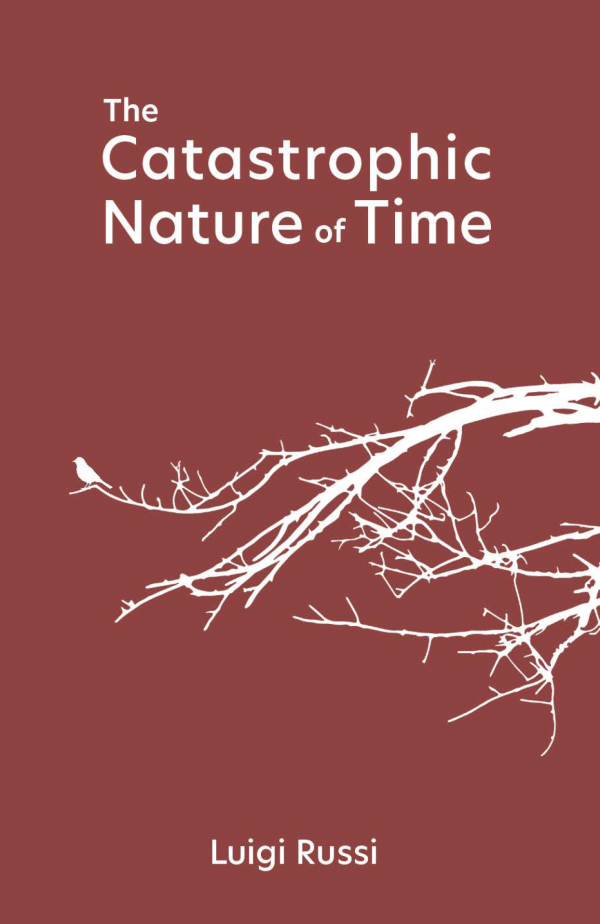
Luigi Russi explores precisely these important and pressing aspects of the current zeitgeist as well as the many traditions that inspire and impose upon said moment in his latest book The Catastrophic Nature of Time. Luigi teaches at a small, Catholic university in Angers, France. He explains how his new book came about, as so many academic interventions, after various conversations of varying intensity with two of his fellow colleagues and members of the Angers Anthropocene Pedagogues: Renaud Hétier, who focuses on psychotherapy and psychology and Nathanaël Wallenhorst, who is influenced by Frankfurt School Critical Theory and publishes regularly on the Anthropocene as rupture and the coming end(s) of the world(s). Finding himself in-between the two, he asked himself “is it possible to look into the future without a complete rupture”? As a pedagogue, his aim, with his new book, was to bring some of these questions concerning time, the Anthropocene, and world endings back into dialogue with scholarship in education. As a teacher, he sees his task as helping people manage the moment of learning, i.e. what he calls the moment of panic. How, then, do we mobilize lucidity as a source of panic in these strange times? While, as a semiotician, he suggests that meaning is “apprehended through some form of mediation” and, thus, this “means already to be a practicing semiotician in one form or another” (2026, 16). Thus, one could say semiotics is inescapable, much like, it feels, the current is moment, too. I sat down with Luigi to explore some of these questions and answers proposed in his brilliant new book The Catastrophic Nature of Time.
MD: In the book you use the metaphor of sea legs to talk about the moment of no longer being sure about stability (be it planetary, politically, socially), but you also speak about climate literacy. How distinct, if at all, are these two aspects (climate and literacy), or, are we always reading earthly ends all around us all the time?
LR: It’s interesting you pick up on this term, because sometimes, in the book, there are terms that I translate from French. In French these terms have currency. So, in France, littératie climatique is indicative that the climate question has become a curriculum. It is taught from high school all the way to university level; I myself teach it. Literacy invokes a human capacity of learning to read; as in, learning to read the climate, but there can also be a bit of a tension because literacy superseded morality. There is a democratic promise in climate literacy when you say everyone should know about it. The French government has really picked up on this but, and this is something I discuss in the book; there is something to be said about that promise, which superimposes itself on a necessary morality that is needed to be human and to converse with the environment. The poetic wisdom of early humans was entirely oral and gestural. It’s good if knowledge is democratised, but there is also a way in which democratising knowledge anesthetizes certain capacities for hearing. Aristotle, after all, wrotePhysics as Natural Hearing. I like that word.
MD: In line with, say the Kübler-Ross model, if we want to really mourn and move towards solidarity and affectual forms of being more in the world with the creatures that are here, then we have to mourn and sit a while with said sadness. I think your book was useful because it doesn’t shy away from that, but still offers avenues for hearing and learning. Can you tell us more about that?
LR: You just evoked Elizabeth Kübler-Ross and it’s interesting because I’ve spent a lot of time in transition towns doing research and Kübler-Ross is very strong in the Anglophone environmental movement as a narrative. While, in my book, there is something distinctly Mediterranean: There is a section on Pompei, I rely on Mediterranean thinkers throughout, and I myself am from the South of Italy. I could never fit myself into the Kübler-Ross model stages of mourning. Being born in Southern Italy, you are already born surrounded by the end of great civilizations since childhood. What I was trying to do with the book, in using the example of Finnegans Wake, was see mourning and loss as a burst of confused creativity. There is something festive about wakes and funerals. There was even a moment in my life when I wanted to be a funeral director. Funerals are certainly very interesting spaces. There is something strangely joyous when you least expect it.
MD: You talk about time and meaning (catastrophic moments) as rejecting the “regularity we thought we had managed to grasp in it” (13). The way I read this is as an inherently in-built revelatory nature of time and catastrophe (apocalypse). Within that there is a rejection of business as usual at a time when business as usual is all that beckons. Do you also see the revelatory aspect?
LR: Clearly my engagement with the word ‘apocalypse’ is through intellectual Catholicism. I find that, within the Catholic church, there is an unbroken relationship to the Middle Ages and that there are often understandings of time that are a direct way of embodying Medieval/preprint consciousness which, equally, aligns with the trend in the humanities of rediscovering the Middle Ages. The title of the book, for example, invokes the words used by Johann Baptist Metz who was a theologian. Time, then, is always open to an unexpected revelation, especially in the Christian tradition, when ‘natural’ and ‘supernatural’ break in a single big, horrific, and festive moment. Apocalypse is a revelatory moment, but that moment looks different for different people. While teaching various people over the years, their apocalyptic moment looks like something arresting and commanding their whole being and attention. My way of meeting that moment is more of a melancholy or perhaps solastalgia. Affects are not logical—change, for example, takes a long time. So, there is a lag when it comes to these moments of realization, while people, of course, also have different experiences of time, which is also figural for what is happening societally more broadly. I have been trying to pluralize said feelings and affects one might have, so that someone can recognize in themselves something they can put a name on. It always comes back to the pedagogical function.
MD: In terms of your choice of vocabulary, specifically in terms of what the ‘Anthropocene’ brings to your work and, for that matter, ‘catastrophe,’ what are their shared grammar and why not opt for one of the perhaps more ‘just’ cognates that have developed out of the environmental humanities and beyond (capitalocene, chthulucene, monstrocene)? Equally, why catastrophe or what you call “unexpected reversals of form” and “how meaning can reappear after undergoing catastrophe” (27) as opposed to, say, apocalypse?
LR: I think what catastrophe, and its theory, gives me is a description of what actually happens in learning. Leaning is still so often perceived as a linear journey. Catastrophe is an unstable area, and, as such, the pedagogue has the work of bringing people in to that unstable area. Apocalypse is revelation and the initial moment, while catastrophe explores the whole process, the whole model. The uncanny is more the quality of apocalypse as it manifests as apocalypse. Instead of taking a completely eschatological view of the final moment, I feel like these instances actually happen again and again. The apocalypse is a stream of liminal moments which add up to the apocalypse as genre. What catastrophe gives me, as a pedagogue, is that one of the layers of dialogue is an unstable, uncanny quality. The book attempts to put in conversation communities that don’t talk to one another: namely the environmental movement and Catholic environmentalists. I didn’t want to engage readers at the level of causes (i.e. the capitalocene or plantationocene), and there are simply so many, while the Anthropocene has really good aesthetic potential. To focus on the geological aspect of it has the greatest potential to make something uncanny. As a pedagogue, I don’t want people to be lost causes and flat out reject anything. Lost causes are unacceptable to me—something that takes people out of a sense of majesty of the earth system, resizes the frame in which they draw boundaries, and then leaves them with that feeling, without saying what the cause is so they can figure it out, is a really good form of pedagogy, which is why I stuck to the Anthropocene.
MD: At one point in the introduction you state that “the aliens we project onto other galaxies might be the very biogeophysical forces of planet Earth.” From such a standpoint, how do you relate to the growing calls for interplanetary exploration?
LR: Some of these big concepts that we have, actually have roots in very ordinary experiences. The interest in alien and extraterrestrial life betrays a buried perception. Some of the beings with which we inhabit the planet have more to say than we are able to ask and listen for. So, I resonate with the feeling of wanting to project outwards. But for me I understand and approach it aesthetically. Like Sun Ra, with Afrofuturism, I want to focus on undertaking that kind of movement with that kind of enquiring spirit of letting the world speak and being ready to listen.
MD: In the conclusion you criticize the attitudes of “accusatory moralizing” and “repression through disavowal” in climate discourse as being symmetric and antithetical. What would a sane conversation on the anthropocene look to you?
LR: Well, it might not begin as a conversation it might begin as a visit to a place possibly. If I wasn’t teaching online but physically, I would take my students to a small slate quarry just outside of Angers which is now a park and I would let them contemplate the strange geographical features of this space. I mean there are many places that people can visit that make the Anthropocene visible. The IPCC reports bring together an enormous amount of complexity so that scientists can have some thresholds to work with and, of course, it’s fundamental. But, pedagogically, this isn’t where I would start. I would start with peoples’ relationships to place and making them see that what these scientists are talking about is clearly and actually visible. You can get creative with this stuff, it’s not dead forever. In Germany they often make parks and museums out of these places and I feel like that’s how we should be having the conversation: from an experience more than an intellectual exchange. It’s about making the Anthropocene visible.
MD: What’s semiotics and how is it helpful for understanding the ecological crisis?
LR: I speak specifically of Peircean semiotics, because French semiology is more focused on the text than the act of reading which implicitly comes with the assumption that what you read is like a text and who reads is a human being. Peircean semiotics is much more abstract and might, at first, seem less appealing. But then, it has great power which allows you to approach the other-than-human world under a communicational lens. As such, we can ask: how is bacteria communicating, for example. Semiotics, and particularly biosemiotics, which is how Peircean semiotics has been extended to the other-than-human world by various big schools of semiotics in Estonia, in Tartu specifically, and in the U.S. I feel like it brings peace to a number of things. You can ascribe communicative powers to the earth without having to deny that human beings have very specific communicative powers that make them distinct from other species. I wanted to impress, especially on the Christian side of things, that we can actually let go of anthropocentricism without letting go of the Anthropos itself. I find semiotics very balanced in this regard. It has helped me to keep this balanced approach. I rely a lot on the work of John Deely who was an extraordinary semiotician who set Peircean semiotics with late scholasticism. I am making an argument that can be heard within the church, which is one of the audiences I speak to, but I also don’t want to alienate readers coming from the ways of being and thinking that come from posthumanism for example or a lot of the environmental humanities. I feel like semiotics has got something formal which adds something to the material turn. There is, by all means, a layer of meaning that is formal and semiotics allows to argue for that. I can, as such, circulate between fields that seem separated. As such, it is my unstable transition in my own personal catastrophe.
MD: You mention in passing several catholic thinkers and philosophers (Thomas Aquinas, Johann Baptist Metz, Donald Gelpi) and even include an epigraph taken from Pope Francis’ encyclical “Laudato Si”: how do you relate the Catholic tradition to something like the anthropocene?
LR: What is specific about the Catholic tradition is that there are two sources of revelation. One is the bible, and the other one is the embodied tradition. So, Catholics believe the way the faith has been practiced is also a source of revelation. You have thinkers like Alasdair MacIntyre who have thought about the idea of a living tradition which is also a question unto itself. It’s a conversation that tries to understand what it is a conversation about. The Catholic world is less affected by events like the French Revolution or the Enlightenment so these big historical ruptures which have marked the intellectual course of France and Germany, and, coming from Italy, I claim a slightly different perception of these things: There is something that is a bit unbroken so to speak. At the same time, there is also a sensibility that this tradition is not traditionalism; it is not the endless repetition of the same. It is a form of critical revisitation of the sources that become a corpus that is written in paper but is also written in stone and glass, in cathedrals, and in human gestures. What I would like Catholics to understand is that the Anthropocene is but the latest call to exercise that form of intelligent reading of tradition which is what has made the church last over two thousand years. There is a large amount of literature on the Catholic imagination and when your imagination can be funded by resources that predate, by a long time, contemporary modernity or even the start of the Great Acceleration you do have a genuine shot, by looking in your own cupboard, at cooking up something that might genuinely be worth tasting for everybody. What I really want to convey to a Catholic readership is: don’t get fooled into thinking it’s other people who have something interesting to say to the conversation; said readership is standing on the shoulders of giants and one has to own that. Aside from faith, the ability to have an imagination funded from the remote past whether it be the Middle Ages, Victorian novels, or William Blake—to claim that as a source of creativity—that’s where I feel there is genuine common ground between the project of the environmental humanities and Catholicism.
MD: What could media theory ever have to say on the anthropocene?
LR: What I’m proposing in this book is, as media ecology looks at media as environments, we should start looking at environments as media. One of my claims is that practices of synchronization and coordination are what make a medium a medium. So far, we have only considered that a medium is something where the practice is readable—or notions of time that we are able to feel—and I think what the Anthropocene is beginning to show us is that we are gaining technologically the capacity to understand patterns of synchronization and temporal organization that we had never imagined which is what brings us to this apocalyptic moment or this sense of panic. This is a moment in which we need to hold that panic and really think on scales of time that have escaped us before, but which are gaining an emerging capacity to synchronize. That’s good news.
Michael Dunn is a Research Associate at the Käte Hamburger Centre for Apocalyptic and Post-Apocalyptic Studies (CAPAS), Heidelberg University, Germany where he works as a copy editor and previously in publication management. He is a final year PhD candidate at Heidelberg University. His research interests focus on climate culpability and justice, extractivism, literary vampires, ecoGothic, and the interconnected crossroads between colonialism and climate change. In 2024 he co-edited Worlds Ending. Ending Worlds: Understanding Apocalyptic Transformation (DeGruyter) with Jenny Stümer. Additionally, he is a translator, poet, writer of fictions, and songwriter performing as M. P. Dunn.
Luigi Russi (Ph.D., University of Exeter) is Associate Professor of Education at the Catholic University of the West of France in Angers, where he forms part of the Angers Anthropocene Pedagogues alongside Nathanaël Wallenhorst and Renaud Hétier. Russi is a communication scholar and a member of the Lyceum Institute working at the intersection of semiotics, media theory, and environmental humanities, attempting to reframe the ecological crisis as a media ecological conundrum. He is author of Everything Gardens and Other Stories (University of Plymouth Press, 2015) and Hungry Capital: The Financialization of Food (Zer0 Books, 2013).