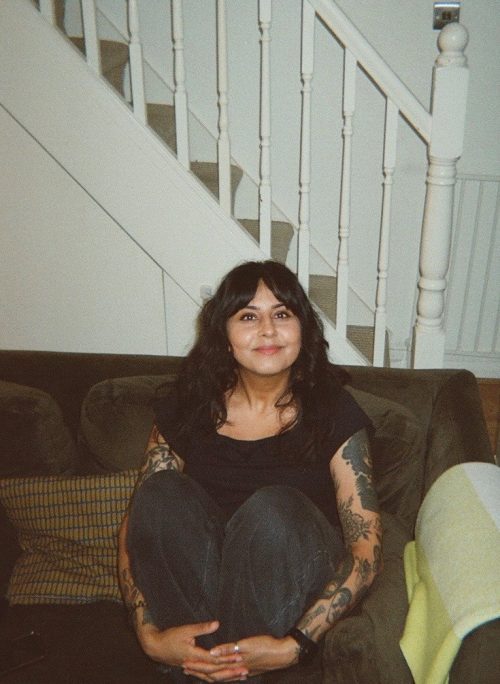
Studies in the Fantastic, in partnership with the Horror Studies Research Group at Northumbria University, is proud to present the second in a series of blog posts highlighting new and exciting research in horror studies. Ami Nisa received Honorable Mention for the Peter Hutchings Award for Outstanding Contribution to Horror Studies, which recognizes the best new work presented at the Horror Studies Now annual research conference. Her essay explores the figure of the vampire in contemporary British Asian culture and politics.
In the summer of 2024, Britain found itself in a paradoxical moment. The country had just appointed Rishi Sunak as its first British Asian Prime Minister and had one of the most diverse cabinets in its history. Yet this same Conservative government was stoking anti-immigration sentiment, and there were far-right riots fueled by Islamophobia and xenophobia. Despite the diversity in Parliament, the social and political unrest seemed to echo that of the late 1960s. In 1968 Enoch Powell was expelled from the Shadow Cabinet of the very same political party after making his infamous “Rivers of Blood” speech. In this speech, Powell used violent and racist rhetoric to criticize mass immigration to the UK, particularly from Commonwealth countries, and opposed the proposed Race Relations Bill (a law that would make racial discrimination unlawful). Powell’s speech is a significant moment in British history and is a key touchstone for far-right ideology today.
Over fifty years on at the 2023 Conservative party conference, the Home Secretary, Suella Braverman, was criticized for evoking Powell’s legacy in her address. Braverman, whose Indian parents immigrated from Kenya to the UK in the 1960s, stated that “the wind of change that carried my own parents across the globe in the 20th century was a mere gust compared to the hurricane that is coming” (qtd. in Seddon). In 2024 the Mayor of London, Sadiq Khan (whose parents emigrated from Pakistan, also during the 1960s) remarked that Braverman was “doing her best to outflank Enoch Powell” (qtd. in Wilcock). What was once an extreme view that resulted in expulsion from political life has since become normalized mainstream political rhetoric. Unlike the 1960s, however, the people in Parliament in the 2020s invoking far-right ideology are often descended from immigrants themselves.
As someone who studies horror films, I see the genre as a powerful lens for exploring what is happening in society, what we are scared of, and what narratives are important to us. I remember when Trump became president in 2017 and the same year Jordan Peele’s Get Out was released. The horror community, and beyond, had a great deal of discussion about Black horror, how historically erased voices were coming to the forefront, and the significance of horror at that moment. I then thought about the UK and wondered where all of our marginalized communities were and who was getting stories made about them. In my opinion, we had a significant number of (very evil) powerful British Asian figures in Parliament that were scapegoating the very communities they originated from. The horror media around me, however, did not seem to be critically engaging with the idea of anti-immigration sentiment. If anything I found it to be supporting it. The far-right ideological co-option of violence against women through the figure of the immigrant rapist (Åkerlund 4) is uncritically depicted in Romola Garai’s Amulet (2020), for example. I found that British horror film, already limited in its depiction of minorities, seemed ill-equipped to grapple with the complexities of race and class in the construction of contemporary British Asian identities.
Gurinder Chadha’s It’s a Wonderful Afterlife (2010) is the only film consistently mentioned when discussing British Asian identity and horror in the past decade. It is a comedy horror film about an Indian mother who kills men who refuse to marry her daughter—she is then haunted by the ghosts of the dead. It’s a Wonderful Afterlife, for context, fits into larger, more accepted narratives in British film. These narratives typically focus on second-generation British Asian characters trying to navigate their parents’ expectations versus British society’s expectations. These narratives often coalesce on a focal point of the spectacle of a traditional South Asian wedding. Even films where this traditional narrative is disrupted, such as Polite Society (dir. Nida Manzoor, 2023), the grand South Asian wedding still plays a crucial element, anchoring these films on a wider, acceptable storytelling standard.
Conversely in 2023, Raging Grace (dir. Paris Zarcilla) was the first British winner of the prestigious Narrative Feature Grand Jury prize at the South by Southwest film festival. It was actually the first British-Filipino film ever produced in the UK. The story centers around Joy, a young mother from the Philippines, who finds herself caring for a terminally ill man in order to support her British-born daughter Grace. It is a great film examining issues around migrant labor and British colonial legacies. In interviews, however, the filmmaker Paris Zarcilla often remarked just how difficult it was to get his film funded because it did not fit into traditional narratives of horror and Asian-ness in the UK: “I thought I had written something that was true to an experience, a British experience, but it didn’t quite fit with people’s idea of what that was” (qtd. in Spencer).
Zarcilla’s experience is underscored by the research in this area. Chi Thai and Delphine Lievens examined British films that were theatrically released from 1 January 2011 to 31 December 2020, and they studied how many of these films featured British East and/or South East Asians (BESEA) in a directing or lead acting role. Here are some choice statistics from their research:
- In the past ten years, nine British films have been released theatrically by BESEA directors, which equates to 0.8% of all releases.
- Three films speak to the culturally specific lived BESEA experience.
- BESEA acting talent in a main role featured in only seventeen theatrical releases in the ten-year period, which equates to 1.7% of all British film releases.
- BESEA actors typically are not cast in a leading role in these films.
- The ethnic backgrounds of the actors were predominantly Japanese and Chinese.
The findings suggest that the British East and/or South East Asian community is marginalized in the film industry, resulting in severe underrepresentation both on and off-screen. So it was with a heavy heart that I realized I was not going to find what I was looking for in horror cinema—I found it in a novel and a TV series instead.
Claire Kohda’s book Woman, Eating was released in 2022. It centers on a young mixed-race Japanese and Malaysian British vampire named Lydia. After her vampire mother gets dementia, she is out on her own in London trying to make it work as an artist while working as an intern in an art gallery. The book is predominantly focused around food and Lydia’s desire to consume. Growing up, she only drank pigs’ blood, but now out on her own she is finding it difficult to source and is being tempted by human blood.
Count Abdulla, on the other hand, is a 6-part comedy TV series, written by Kaamil Shah and released by ITVX in 2023. The series follows Abs (short for Abdulla) a British-Pakistani Muslim junior doctor working in the NHS. Abs is bitten by a vampire, and the series, adhering to the tropes I mentioned earlier, follows his difficulties in managing his community’s expectations and his new identity as a vampire. It also follows the trend of also including a big South Asian wedding as a spectacle.
I thought it was interesting that at this moment in time there were two different manifestations of a British Asian vampire. The figure of the vampire is essentially a monstrous parasite that lives off others—common rhetoric used to describe migrants by the right wing in the UK. Within the context of rising racism and anti-immigration sentiment in the UK, I was interested to see how these forms of media grappled with this concept and attempted to subvert it. The vampires here are significant figures as they are not just presentations of Asian identities within a vampiric form, but that of specific diasporic identities formed by Britain’s colonial past.
Vampires as we know them in the Western world are historically diasporic figures; Count Dracula himself moves from Transylvania to London. Simon Bacon suggests that the figure of the vampire is often historically aligned to Jewishness and can be understood as a cipher for the diasporic Jewish experience:
The very nature of the vampire can be seen to embody both the violence of history and the recurrence of traumatic memory, not least through the act of their transformation from human to vampire, their subsequent feeding and extreme longevity. Traditionally, the result of this act of transformation was the separation and segregation of the vampire from the “normalized” human species, positioning the vampire as Otherness incarnate. (111)
Bacon recognizes the figure of the vampire as something through which history can be understood. The vampire is an embodied manifestation of the passing of time and they carry memories of the past into the present that they exist in. This is made more significant when the vampire is read as a Jewish migrant figure, displaced from their country of origin due to persecution and perceived as monstrous both by the people from where they came from and by the people in the new place they have settled in. Although vampires may appear humanlike, they exist in a constant state of otherness and alienation from their surroundings.
This existence of otherness and alienation means the vampire is often an important representational figure for communities of people that have been historically marginalized. The vampire’s links to queerness, for example, have long been documented (and can also be found in both texts I am examining). Getting back to the vampire and alienation, there are examples of media where the vampire is explicitly examining diasporic identity. A notable one is A Girl Walks Home Alone at Night (dir. Ana Lily Amirpour, 2014), which is an American film yet is set in a fictional Iranian town with Farsi dialogue; the film is unambiguously a negotiation of Iranian and American identity.
The two depictions of British Asian vampires in Woman, Eating and Count Abdulla take a unique position, however. Where A Girl Walks Home Alone at Night is almost timeless and placeless, Woman, Eating and Count Abdulla are very specifically contemporary British stories that are firmly rooted in their characters’ economic realities. These economic realities are shaped by racial capitalism, which requires racialized labor to function. In devaluing and controlling a set of people they become acceptably exploited. As Jodi Melamed explains,
Capital can only be capital when it is accumulating, and it can only accumulate by producing and moving through relations of severe inequality among human groups—capitalists with the means of production/workers without the means of subsistence, creditors/debtors, conquerors of land made property/the dispossessed and removed. These antinomies of accumulation require loss, disposability, and the unequal differentiation of human value, and racism enshrines the inequalities that capitalism requires. Most obviously, it does this by displacing the uneven life chances that are inescapably part of capitalist social relations onto fictions of differing human capacities, historically race. We often associate racial capitalism with the central features of white supremacist capitalist development, including slavery, colonialism, genocide, incarceration regimes, migrant exploitation, and contemporary racial warfare. Yet we also increasingly recognize that contemporary racial capitalism deploys liberal and multicultural terms of inclusion to value and devalue forms of humanity differentially to fit the needs of reigning state-capital orders. (77)
One example of this can be seen in the NHS. Around 9% of the UK is of South Asian ancestry (“Ethnic Group, England and Wales”), yet around 30% of doctors in the UK are from a South Asian background (Stockton and Warner). When the NHS was first formed, there were massive gaps in the workforce. To fill these gaps, the British government used people from its former colonies to bridge the gap. In a debate in the House of Lords in 1961, Lord Cohen of Birkenhead commented on the fact that “[t]he Health Service would have collapsed if it had not been for the enormous influx from junior doctors from such countries as India and Pakistan” (qtd. in Esmail 830). Lord Taylor of Harlow in the same debate said, “They are here to provide pairs of hands in the rottenest, worst hospitals in the country because there is nobody else to do it” (830). They were, and still are, typically placed in much worse working conditions than their white British counterparts. The NHS would not exist if it were not for migrant labor and for the exploitation of the people Britain had formerly colonized. This idea is made explicit in Count Abdulla.
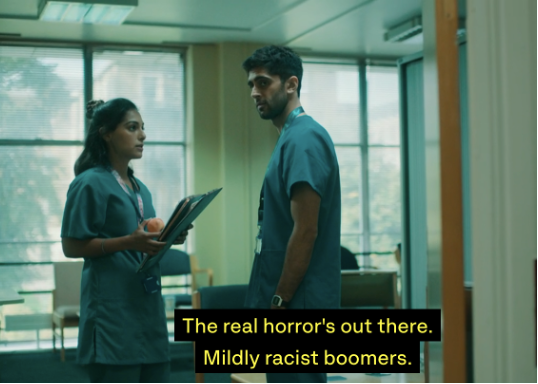
Throughout Count Abdulla, the series confronts the racism faced by non-white medical professionals. In one salient scene from episode 6 (The Shadow over Heathrow), Abs is shown stealing blood from a transfusion bag, an act born of necessity after being unknowingly turned by a white vampire. To survive, he must siphon blood from the very hospital where he works. This moment serves as a powerful metaphor: despite being essential to the NHS workforce, a presence rooted in colonial history, non-white professionals are often portrayed as burdens or drains of resources. Abs, as a British Asian vampire, embodies the paradox of British Asian identity within the NHS, underscoring the tensions of belonging, labor, and diaspora in a system that both relies on and marginalizes him. The series speaks to very specific diasporic experiences.
Lydia’s experience in Woman, Eating, on the other hand, is very different. Where Abs is clearly noticed and singled out as an outsider, Lydia’s experience is that of invisibility and erasure. She is working as an unpaid intern at a small gallery. Here are some quotes from the novel that illustrate how she experiences this invisibility and erasure, how she is continually an unseen presence:
I look at him from the corner of my eye. He’s wearing a black shirt with a high collar that covers most of his neck, formal trousers and an ornate waist-coat. I suppose he looks how any normal person might expect a vampire to look. (49)
The receptionist barely acknowledges me. She shouts out to a woman with blonde hair, wearing a bright green coat, “Another one for you,” and the woman replies, shaking her head, as if I’m not there. (50)
What is significant here is that in the first part, Lydia is expressing a kind of vampiric double consciousness. She is looking at herself and how she is perceived and measuring that against others—she notices someone who she thinks other people would think is a vampire. Her identity is that which is mediated through a specific cultural understanding of what the dominant understanding of a vampire is, and she does not match up to that. She is understanding herself through the eyes of others. Her invisibility is further compounded by the man completely ignoring her. In the second part, she is then faced with the receptionist, who also acts like she isn’t there. Lydia is referred to as “another one.” She does not have a name.
As previously noted, East and South East Asian identities remain significantly underrepresented across the UK media landscape. While Count Abdulla draws on quite tired tropes, there is a warmth and familiarity present in the TV program as a whole. Woman, Eating, however, is marked by a severe sense of disconnectedness. Lydia the character is alone now that her mum is in a care home with dementia, she is invisible to the people around her, and in some ways her identity as Malaysian-Japanese-British person is invisible and not widely understood.
In summary, the emergence of British Asian vampires at this particular moment in British media history carries profound significance. These figures reimagine the vampire as a diasporic symbol of memory, uniquely capturing the lived experiences of marginalized communities and their entanglement with Britain’s colonial legacy. By adopting the form of a parasitic and monstrous entity, these narratives reflect and critique prevailing perceptions of British Asian identity within contemporary society, exposing the tensions between visibility, labor, and belonging.
Works Cited
Åkerlund, M. “The Racialisation of Rape: A Far-Right Tool for Boundary-Creation Across Borders.” Nations and Nationalism, 1–14, 2025. https://doi.org/10.1111/nana.70007.
Amirpour, Ana Lily, director. A Girl Walks Home Alone at Night. SpectreVision, 2014.
Bacon, Simon. “The Vampiric Diaspora: The Complications of Victimhood and Post-memory as Configured in the Jewish Migrant Vampire.” The Modern Vampire and Human Identity, edited by Deborah Mutch, McFarland, 2013, pp. 111-24.
Chadha, Gurinder, director. It’s a Wonderful Afterlife. Indian Films, 2010.
Esmail, Aneez, “Asian Doctors in the NHS: Service and Betrayal.” British Journal of General Practice, vol. 57, no. 543, Oct. 2007, pp. 827–34.
“Ethnic Group, England and Wales: Census 2021.” Office for National Statistics, 29 Nov. 2022, www.ons.gov.uk/peoplepopulationandcommunity/culturalidentity/ethnicity/bulletins/ethnicgroupenglandandwales/census2021. Accessed 12 Oct. 2025.
Garai, Romola, director. Amulet. Magnolia Pictures, 2020.
Kohda, Claire. Woman, Eating. Virago, 2022.
Manzoor, Nida, director. Polite Society. Focus Features, 2023.
Peele, Jordan, director. Get Out. Blumhouse Productions, 2017.
Seddon, Paul. “Suella Braverman: We’ve been too squeamish on migration.” BBC News, 03 Oct. 2023, www.bbc.co.uk/news/uk-politics-66999209. Accessed 14 Nov. 2024.
Shah, Kaamil, writer. Count Abdulla. Fudge Park Productions, 15 June 2023. ITVX, www.itv.com/watch/count-abdulla/10a3156.
Spencer, Katie. “Raging Grace: The Horror Film Inspired by Britain’s Mistreated Migrant Workers.” Sky News, 29 Dec. 2023, news.sky.com/story/raging-grace-the-horror-film-inspired-by-britains-mistreated-migrant-workers-13038916. Accessed 12 Oct. 2025.
Stockton, Isabel, and Max Warner. “Ethnic Diversity of NHS Doctors.” Institute for Fiscal Studies, 22 Jan. 2024, ifs.org.uk/publications/ethnic-diversity-nhs-doctors. Accessed 12 Oct. 2025.
Thai, Chi, and Delphine Lievens. “The Exclusion Act: British East and South East Asians in British Cinema.” Representology, vol. 2, 2021, www.bcu.ac.uk/research/media-and-journalism/sir-lenny-henry-centre-for-media-diversity/representology-journal/representology-journal-vol-2/the-exclusion-act–british-east-and-south-east-asians-in-british-cinema.
Wilcock, David. “London mayor Sadiq Khan accuses ex-home secretary Suella Braverman of ‘doing her best to outflank Enoch Powell’ with claim that ‘Islamists are in charge’ of UK after Commons Gaza vote chaos.” Daily Mail UK, 23 Feb. 2024, www.dailymail.co.uk/news/article-13118017/Sadiq-Khan-Suella-Braverman-Enoch-Powell-Islamists.html. Accessed 14 Nov. 2024.
Zarcilla, Paris, director. Raging Grace. Last Conker, 2023.
Dr Ami Nisa is an Early Career Researcher. She is currently Research Assistant on the “Autism from Menstruation to Menopause” Wellcome Trust Funded project within the Faculty of Medicine, Health, and Life Science at Swansea University. She completed an interdisciplinary PhD in Sociology and Film at Northumbria University, examining the social construction of technology and theorising non-human agency in found-footage horror cinema. She is interested in how marginalised groups can be othered and conceptualised as non-human.