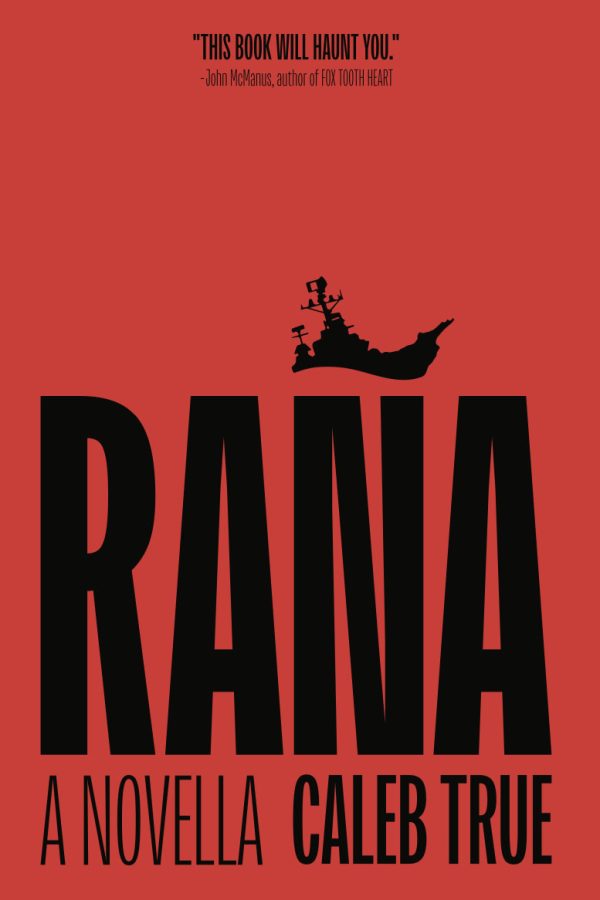
University of Tampa Press student intern, Phoenix B. Lloyd, interviewed Caleb True about writing his novella, RAÑA, available now for preorder! RAÑA is the fourth novella published by the University of Tampa Press’s Pomme novella series, which will open again for submissions in Spring 2027.
PL: What was your creative intention behind repeating the words “pause,” “play,” “fast-forward,” & “rewind” throughout the novella?
CT: I think it was a fun and (as far as I know) original way to allow for a common novel-writing strategy, which is to work out of chronological order, directed instead by the flux and swing of memory and emotion. The analog-cassette-type ordering combines nicely with the VHS tape-watching Raña does. This was of course intentional. It was Lucian’s idea to have more boxing-match watching in the novel to pump up the power of the gimmick and make it this wonderful, consistent thing that it was trying to be. I realized the other day that I totally stole the idea from myself. In an earlier short story I published in Faultline called “The Clown of the Times,” which fictionalizes some hiking in India and other hippie adventures of my father and his back-to-the-earthy friends in the sixties and seventies, I super duper use the Rewind-Fast Forward-Pause chronological ordering strategy as well. I had completely forgotten this, even when I had written the first draft of RAÑA.
PL: How would you define Raña’s internal struggles and the possible root causes for them?
CT: I love Raña. His struggle consumes him; it’s also a passion. I write often about art monsters who allow their passions to drive and consume and envelop their entire lives. No compromises, no family, alienation of any and everyone who might distract, dilute the focus and the striving. Raña’s kind of like that. His striving is relatable and honorable, even if it’s self-destructive.
And his seeming disease of meaning and being is largely externally created. We could blame the colonizers of centuries past for creating a system of exploitation and mass trauma which carry down the generations to Raña’s time. There is also the vengeful Reaganite and Thatcherite 80s regimes of the dominant West, which continually screwed South America and its attempts to move past autocracy to democracy. Thatcher is certainly to blame for the violence in Raña, but she didn’t originate the great traumas, for there would be no Raña without the arch-trauma of colonialism, exploitation, the mosaic of forced diasporas that made the new world and created the cultures and myriad problems we have now. It is bittersweet, too. The great crimes of history have created breathtaking multiculturalism in new world lands that were colonized between 1500-1900.
I have very mixed feelings about the art and artifice of historical fiction. I have a masters in history and it is really somewhat troubling that people often get their ideas of history (“what really happened”) from fiction that masquerades as historically accurate. I think it was Ridley Scott with his Napoleon biopic who was challenged by historians about a lot of the assertions in the film that are not in any way supported by the historical record, and his response was, basically, for them to go fuck themselves: that he’d earned his license by being wildly, enjoyably entertaining. So, while an intelligent person would not watch Napoleon and imagine that is exactly how things went, the upshot is a lot of people will, when imagining the historical Napoleon, inevitably imagine a mumbling Joaquin Phoenix, a Prussian Army tricked onto the ice and drowned beneath it.
My assertion, as a novelist and a historian, is to understand that all writing on history, by definition, risks fictionalization. Historical fiction should, at the greatest remove from the evidence, be the most self-consciously (and self-admittedly) invented. Books of the practice of history, published by academic presses (one throws up one’s hands about trade publishers and their ‘history’ titles), ought to hew close to the evidence. It’s a pet peeve of mine when “historians” writing history books still opt to work in a novelistic, narrative mode to serve a more ripping yarn. How dare they! Just write an historical novel if that is what you must do to keep your readers (or agent) from nodding off.
There’s also a trap of historical fiction where, like with other kinds of narratives, a writer could be profiting from, monetizing the trauma of others, the traumas of the past. With this, I think generally it comes down to a matter of taste and artfulness. It would be difficult, for instance, to write a novel set against the backdrop of the holocaust that adds to the literature, that says something, in a narrative context, that has not already been said by the history, by the reportage, by the memoirs and the many previous novels set in and about the holocaust. The same can be said of any period of history that’s been thoroughly plumbed for narrative and for a backdrop to someone’s personal (or imagined) story. I think this requires fans of historical fiction to simply work harder to find things that haven’t been explored so thoroughly, but of course that’s a pretty big ask.
RAÑA lives amid an historically accurate backdrop. One should not read it in order to learn, too specifically, about the Malvinas War. Maybe generally, but not specifically. Alas, people probably will. Raña’s story, his narrative, his life, his epic journey, are his own; he is a believable character living in an extant reality. It still begs the question: why write historical fiction? I’m addicted to it; I think the great, jaw-dropping backdrops of historical epochs always interest me more than the current, than my own life “experience.” The ordinary is simply that, ordinary. To me, quite uninteresting. Also, for the most part, there are no cell phones, so that’s wonderful. The impulse to write fictional narratives that sit in history is timeless: Viking Sagas were embellished, Echtra and Immrama were as well. I love history as much as myth and fable. If you go far enough back in time, these all merge together, and the realistic quality of the merging is to show that life still has (and has always had) impossible turns to it; insistence on the influence of ghosts; caprice; luck; superstition; divine influence: people are still living quite contentedly, half in the real world, and half in the Otherworld. If anything, recent events have shown that we might be in a great reversion into fantasy, and away from the supposedly shared reality that science and scientific inquiry has supported since the enlightenment. This might, however, be an overstatement of the influence of the enlightenment.
PL: At the start of page 12, lines 1-6 really stood out to me:
“The terror of returning home. What’s left for Raña in Villa Ocho? Rewind—pause. Replay the same scene a hundred times. Raña’s mother on the foldout chair by the screen door in the kitchen. The sun has set, glows the hills. She sits sideways to the screen door smoking a cigarette lit at the stove, watching the hills until the light’s gone.”
This is the only time in the story any scene is replayed hundreds of times in Raña’s mind. What was the significance of this scene to you when you were writing the novella? What does it display about Raña?
CT: I think I wanted to show what a “day after school” looked like. Lonely, self-entertained, curious. Why is mama so lonely? Kids raised in front of the TV when the alternatives aren’t pleasant or inviting. Single parents raising children: it’s hard; life has to be gotten through, simply, sometimes. life is often made of up moments that simply need to be tolerated as best they can, through repetition, through mindless dissociation, and these moments can really make their impressions on someone. The routine of a day after the day has ended, the school day, say, would indeed have occurred hundreds, if not thousands, of times. Eat, watch a movie, play by yourself, etc. I wanted to bring that melancholy reality some magic. If the teenage Raña hasn’t imagined boxing yet, watching videos over and over of boxing matches, of heroes for Raña, he is being setup to imagine boxing as a quintessentially beautiful and worthy pursuit. Primal. Even less accoutrement that required of the great heroes of soccer, who need a ball, goal posts. The boxer has his fists only. The boxer barely even wears clothes.
PL: What influenced you to create the supporting character, Bonifacio? How do his choices and attitudes portray Raña to the reader?
CT: I think Bonifacio was created so we could have someone to look at Raña and judge him in a way he cannot judge himself (or the authorial intrusive voice also cannot). There are heaps of ironic distance in RAÑA, but Bonifacio also allows Raña to have adventures, to have a friend dynamic (be it, kind of, main character and sidekick, alpha and beta, an uneven partnership). Even the friendless need (and have) friends.
PL: The imagery used to paint Villa Ocho was brilliant as it kept a senescent vibe throughout the story. It was described to be unchanging and stagnant which mirrored some of the behaviors Raña grew into after observing them in his mother with disdain. How do you think that the setting influenced the characters and how much of Raña’s upbringing influenced who he became and what he valued as an adult?
CT: I think when drawing Raña, I wanted to start with a well-meaning young man who had the desire to do great things, and the drive to insist on that desire in his life, become gradually disillusioned by the complete lack of caring by anyone around him to do anything correctly, by the law, nobly, interestingly, or with any passion. This is a universal bildungsroman trope: Bright-eyed-young-person-has-outlook-darkened-by-reality-and-disappointment. The war is mostly what ages him, turns him into what he fears most, a denizen of a stagnant backwater cow town, that thing he was trying to escape. Rather than some failing in his upbringing (which was, all in all, not too bad), it was colonialism, its late shade (Thatcherism, the insistence on war, Reaganism, CIA meddling and their support of a dictator who bled the country, that dictator’s own perversion of the Malvinas grab in order to distract from his exploitation of the country), and other negative after-effects which produced an angry young Raña. War, too, objectively speaking, always tricks young men seeking greatness. Young men come back old and damaged, or don’t come back at all. The compensations for going to war for kin and country are usually insufficient, the morals usually degraded. Raña learns this firsthand and is smart enough to know he’d been had. It adds to his seething rage.
PL: What literary works influenced the writing of this book? Where did you get the idea for this book? In this novella, which sections were easiest to write, and which parts did you wrestle with? How did you evolve throughout the process of writing this novella? Do you have any writing craft advice on the process of writing a novella?
CT: I have always loved historical epics. I think close to when I started imagining writing RAÑA (the first draft, rather, about ten years ago) I had read or was reading DiBenedetto’s Zama, which is a super important work of Argentinian 20th century letters, recently made into an also exceptional movie by Lucrecia Martel. It was only translated into English a few years ago and issued by NYRB. Another forgotten international epic/classic that was blowing my mind around that time was Aniara, the epic futuristic poem by Harry Martinson, a Swedish 20th century classic.
The actual germ of the writing of this book came earlier, however, when I farcically synopsized RAÑA as a novel titled “HAEMATOMA” by the reclusive, fictive novelist Yves Goss in my great American novel (not yet contracted) “MILLENNIALS,” written a few years before I wrote RAÑA. The essentials of RAÑA are there in the synopsis of “HAEMATOMA”: the fact that it’s the only (and improbably) epic of the Malvinas War, starring an Argentinian pugilist and veteran who struggles to fight the Malvinas War every time he enters the ring and ends up sparring with the ghost of Sir Richard F. Burton, explorer. It was supposed to be impossible, ridiculous, expansive, imaginative, fantastical, and the actual writing of the work was the most fun as a challenge prompt, to write such a strange little, impossible, magical book.
I don’t think any actual sections were difficult to write. I don’t usually struggle with writer’s block (I don’t understand what that means; not trying to be pretentious, I’ve just never really had it), but I suppose I could discuss the sections of RAÑA that I added later, after I consulted with my good friend, poet, and Argentinian-American Lucian Mattison, who read early drafts and gave me pointers and good, juicy ideas for local color and colloquialisms. We’re talking like 3-4 years later, after a few of my own edits, and some time to change my mind multiple times about whether the book was good enough to share or not. These would be the sections where Raña’s at home, watching video casettes of famous fights, especially Ali-Bonavena, and his mom is in the other room. These were meant to fill out some domestic space, some childhood memory, and add intrigue to his mother/father mystery and development.
I think my advice about writing a novella is the same as writing a novel. You could say that to write a novella is easier than a novel because it is, like a short story, easier to grasp the entirety of it, in the mind, all at once. In fact, RAÑA, by some measures, is so short as to not even qualify as a Novella, but rather a “long” short story. Ha, ha. I hate such designations anyway. And, as a publisher myself (I’m the founder (est. 2015) and managing editor of Dynamo Verlag), one can create a very gorgeous, reasonably paginated and formatted 100ish-page book from a manuscript of even as little as 8,000 words. Hence Dynamo Verlag’s annual Book Contest’s strange word count range of “7,000-100,000 words” to make a book.
In Europe, unless an author chooses to self-identify a work as a “novella,” these short works are just “novels.” Pierre Michon’s Abbes is a 60-odd page “novel”; Matthias Enard’s Tell Them of Battles, Kings, and Elephants is a scant 130 pages (with plenty of blank space); de Kerangal’s Eastbound is a tight 100 pages in a very small format (so, likely under 20,000 words), as is An Untouched House by Hermans—the list goes on, Antonio Tabucci, Leonid Yuzefovich, Halldor Laxness, Giono, Jünger: the point is, outside this country, there is no hangup about this middling designation of novella, to catch a category of “not long enough” (for who? begs the question: I don’t know a soul who cares that a book is 400 pages rather than 100) novels that sit between “long enough” novels and “long” short stories. I know RAÑA is a loving part of the University of Tampa’s Pomme novella series, and that is absolutely fantastic. I am proud that it is a novella, and, for its high level of poetics, it is a huge value per word. But, as a publisher and a writer of many, many novels which span the range from very short novel (contracted: RAÑA, uncontracted: AMERICAN PHANTASMAGORIA, ZERO, THE ANACHRON, EUROPE IS A RATCHET COUNTRY, ULU BOYAR, etc.) to very long novel (uncontracted: MILLENNIALS, ZUFRIEDEN, AMERICAN RICHES, INTO DEEP DARK, DOVERIE, WARM GUN, etc.), I feel quite strongly about it. If an author calls it a novel, it’s a novel. If they call it a novella, it’s a novella. If they call it a short novel, it’s a short novel, etc. Richard Brautigan’s 26-word novel is a novel. And so on.
Oh yeah, the question was about craft advice. Here’s my craft advice for writing anything longer than a short story: Try to combine two “good ideas,” rather than trying to spark inspiration just from a single “good” idea. I typically try to cross two (or more!) strange ideas to maximize cross-pollination and give me a lot to dream from and dream up. And, if possible, keep to a schedule. Once I’m in a project, I try to write fast, and on a schedule, with a quota each day. When I was young, and insane, my mandatory minimum when I was working on a novel was 5,000 words per day. These days, for the sake of not needing to take huge breaks and/or give myself back problems, that is now 2,000 words/day. Still, the point is to continue to make decent progress quickly, otherwise you’ll lose the big picture and momentum. Seriously. I have no idea how someone like Gustave Flaubert or Aimee Bender can write “one page a day” and maintain any kind of sense of the whole (or have to waste huge amounts of time with detailed notes on plot, etc.). A short story ought to be something someone can write a first draft of in one day; a novella is something someone ought to be able to write a first draft of in one week; a novel ought to be something someone can write a first draft of in one month (or less). I believe the first draft of RAÑA was written in a couple weeks, working fairly casually (I can’t remember, probably somewhere from 1,000-2,000 words per day). While the first draft was closer to 20,000 words, RAÑA was always meant to be short and sweet, very poetic, a heavy-hitting wisp of a thing.
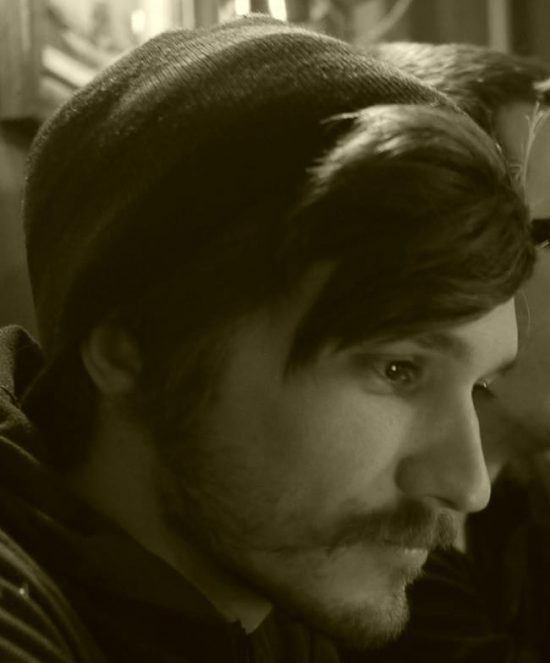
Caleb True is a writer, editor, critic, musician, athlete, and podcaster. He holds an MA in history from the University of Massachusetts and an MFA in creative writing from Old Dominion University. He is the author of the critical essay On Ruben Slikk: A Manifesto on the Purpose of Art and the Value of Transgression (Dynamo Verlag 2024) and Chansons Russes (Quetzalcoatl 2016; Dynamo Verlag 2023), a historical triptych of stories set in Soviet Russia. He has published short stories and essays in Ploughshares, The Sonora Review, Faultline, Yemassee, Whiskey Island, and many others. He is the founder and managing editor of Dynamo Verlag (est. 2015), a boutique publishing house specializing in textual work demonstrating genius, eclecticism, and originality.