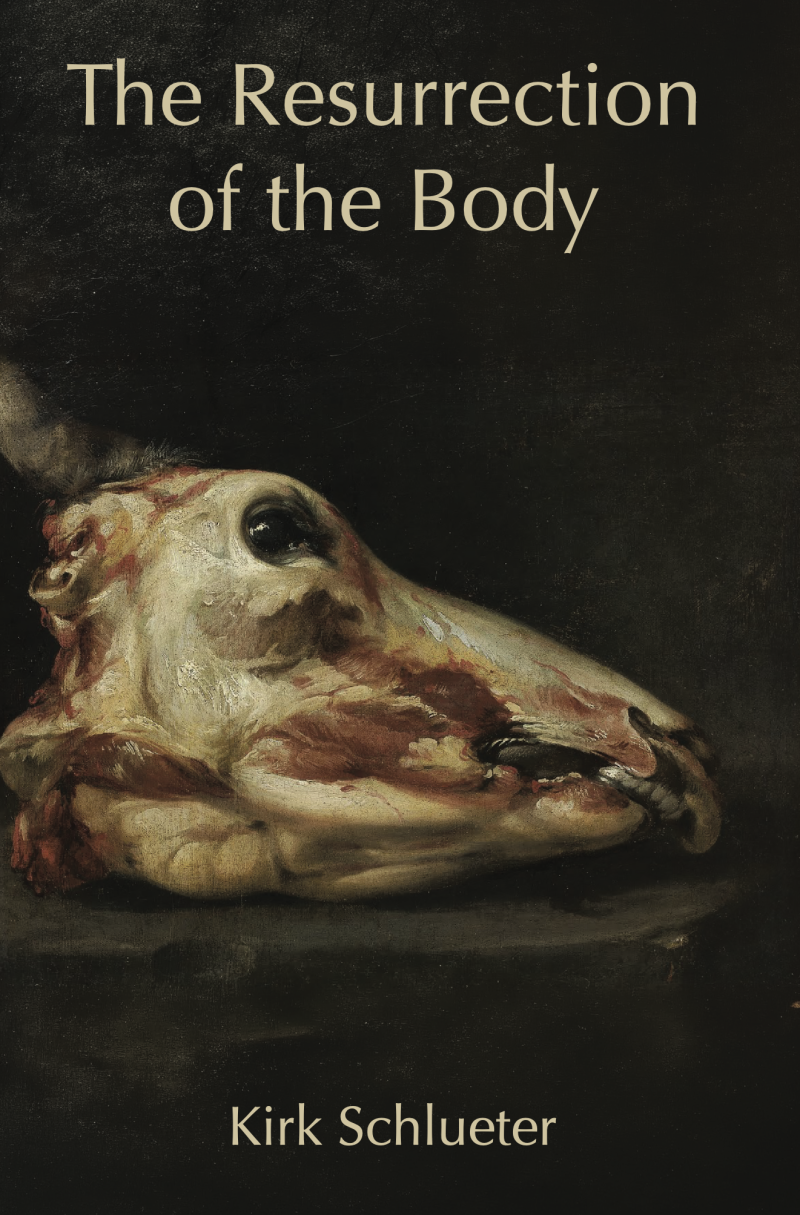
Kirk Schlueter’s The Resurrection of the Body is the 2025 winner of the Tampa Review’s Richard Mathews Prize for Poetry. Managing Editor, Jay Aja, sits down with the poet to discuss Schlueter’s poetic influences and craft choices in composing his debut collection, which serves as a necessary answer to the underrepresentation of poetry centering male disordered eating.
Jay Aja: Who are the poets who most inform and inspire The Resurrection of the Body?
Kirk Schlueter: This is a great question because no one has ever written in a vacuum. At an elemental level, this collection bears the hallmarks of Judy Jordan and Allison Joseph, my mentors at Southern Illinois University-Carbondale. I also found myself really drawn to Lisa Russ Spaar’s Glass Towns while writing: Jennifer Key taught this book in a workshop at SIUC right before I started writing the anorexia poems. At the time, I remember I hated it and thought it wasn’t very well-written; now I’m pretty sure I was just avoiding the topic altogether so I wouldn’t have to acknowledge my own baggage. Therapy works, kids!
There’s also a lot of Bruce Snider in these poems, especially from his sublime collection Paradise, Indiana. It’s a splendid exploration of personal trauma intertwined with the Midwest, and that’s certainly something I’m very drawn to. Brian Barker’s Animal Gospels was also a manuscript I read time and again during writing, and I’d be remiss not to mention the impact Sara Eliza Johnson has had on my diction choices over the years. Finally, there’s Traci Brimhall’s Rookery, one of the most perfect first books I’ve ever read, and absolutely a touchstone as well.
JA: Are any of the poems in The Resurrection of the Body in conversation with any of these influential poets’ works?
KS: The answer has to be yes, even if I’m not always aware of it. To take just one example, Paradise, Indiana has a recurring motif of deer and hunting, and I certainly borrowed from that when composing my own poems about deer. Deer belong in poems; sorry, I don’t make the rules, but if you’re writing a book in the Midwest, you’ve gotta have deer. “The Storm & What It Meant” borrows pretty heavily from Brian Barker’s jaw-dropping “Crow Gospel Coming Down the Mountain,” a poem I’ll never get tired of reading, and the same is true of “That Summer, I Became A Deer”—that poem is trying really hard to be a Brian Barker poem.
I could probably go on here for a while but my overall message to burgeoning writers is: write your response poems! Write your version of poem “X” that really draws you in. It’s great practice, and work with it enough, it will evolve away from the original and more into your own piece.
JA: How has writing about male anorexia changed your own relationship to your body?
KS: I wish I had fixed it and wrapped it up neatly. The truth is I’d very much still describe myself as an anorexic in recovery, similarly to how addicts do. When I get stressed, or if I go too many days without exercising, or eat a lot of dessert and have a full stomach, or (pick your trigger here), those feelings absolutely come storming back. It’s such an easy temptation.
Where writing has helped is making me much more aware of my relationship with my body: paying attention to what it’s doing and how it’s feeling, but also trying to feel positive toward it, rather than something I’m disgusted by. And hopefully that informs my decisions, too. Just recently I decided not to give up sugar or alcohol for Lent because that feels too tied to dieting for me . . . which is too tied to anorexia. It’s a journey, what can I say.
JA: How do you see your body in connection with the landscape in these poems?
KS: The body taking on the attributes of the landscape and vice versa is one of art’s oldest tricks, and I’m happy to play along with it. I like the idea that the landscape mirrors the speaker’s body and how he feels toward it throughout the collection. The inspiration for the “Selfie” poems in the book came from that impulse, and an off-hand comment Roger Reeves made at a literary conference once about the difference between a selfie and a self-portrait: in the selfie, the self is always fixed in whatever landscape they’re present in at that moment as opposed to the self-portrait’s blank canvas.
One of humanity’s great delusions is that we’re somehow separate from the natural landscapes around us, when in fact the landscape often shapes everything about our world. This can be something as small as what gets us sick (virus, bacteria, fungus) to our entire society (Midwestern towns often revolve around agriculture and industry because the last Ice Age flattened our land and helpfully deposited a bunch of Canadian topsoil). The most interesting book I read last year was Caroline Fraser’s Murderland, whose thesis is that the serial killer boom in the Pacific Northwest during the ’70s and ’80s was primarily caused by exposure to atmospheric lead smelting. Now the jury is sort of out on the scientific veracity of that claim, but the images in that book—kids playing around smelters, people taking tours inside refineries, industrial workers coming home and their bathtub turning green as they rinsed off chemicals—are something out of a horror movie. We can’t escape our bodies, and we can’t escape the landscape, and we definitely can’t escape the two of them together.
To use another metaphor, in The Resurrection of the Body, the landscape and the body serve as fractals: they have the same shape no matter what scale they’re viewed at, from 10,000 feet or down to individual rocks.
JA: Which are your favorite poems in The Resurrection of the Body and what was your process like in writing and editing them?
KS: Is it wrong to say all of them? (Yes, yes it is). My favorite poems in the collection are the ones where I was doing something new during the writing process. “Frankenstein’s Monster Describes Resurrection” is one that stands out. It was the first real persona poem I ever wrote, where I was trying to take on something else’s voice and make that speaker’s struggles relevant to mine. I remember being very surprised by how well it turned out, and it’s also responsible for one of my best poetry “flow states” ever, where I stayed up until well after midnight, pacing in my kitchen and repeating each line aloud until it had the sonic pattern I wanted.
“A Too-Late Apology to Miss South Carolina Teen USA 2007” is up there as well for the title alone, and I’m very happy with how the poem moves from what’s originally humor to something meaningful about aging and changing. That one came to me very much like a lightning bolt: it’s one of the few poems I’ve written in one setting where not much had to be changed after the initial draft—normally I’m five drafts in before I’ve realized what the poem is actually trying to say.
Finally, there’s “Male Anorexia.” I really challenged myself with this poem—I felt that the book needed a more bracing opening that called the reader’s attention to its major themes and let people know what the book is about, but I wanted to tackle the subject in a different way. Much of my poetry is very direct: I like big, declarative statements. I think most poets take Dickinson’s “tell the truth, but tell it slant” too far until they’re writing only about the shadow of something, not the thing itself. For this poem, I decided to be more oblique, less direct—a softer tone that declares its theme up front and then communicates it through lush language. While I wouldn’t want this to be my style all the time, it felt very nice as an aesthetic break, and I enjoyed the composition process a lot.
JA: Who do you think your collection is written for the most?
KS: I think everybody’s first poetry manuscript is, with exceptions, written for a younger version of the poet: it’s the thing that the author needed to read X number of years ago to understand their life. The Resurrection of the Body definitely falls into that category, and so while I hope it’s appealing to many different audiences, especially people who are struggling with body image or disordered eating, I’d be lying if I didn’t admit that its ideal reader is a young Midwestern man. I still haven’t seen much work present in poetry (or art in general) about male disordered eating or body image disorders. Hopefully those people can feel acknowledged and validated if they find this collection.
I’ll say as a closing note here that one of the benefits of publishing individual poems in the collection is having multiple acquaintances and friends reach out afterward to share their own struggles and journeys—and often these folks are not ones I would have ever thought of as fitting this category. I think negative body image and disordered eating (maybe not full anorexia or bulimia, but low-grade body abuse) is far more prevalent than measurements say and is common in the American DNA. This book is my testament to that.

Kirk Schlueter received his M.F.A. from Southern Illinois University-Carbondale and his B.A. from Truman State University. His poetry has been awarded an Illinois Arts Council award and the 2018 Frontier Poetry Prize. Individual poems have appeared in magazines such as Bat City Review, RHINO, Diode, Nimrod, River Styx, Passages North, Grist, Frontier Poetry, Ninth Letter, Natural Bridge, The Pinch, Tinderbox Poetry Journal, and Connotation Press among others. He lives and teaches in St. Louis and its Illinois suburbs.

Jay Aja (dey / dem / deir) is a second-generation-immigrant Guyanese poet and comics artist whose work explores queerness and transmasculinity. Jay’s work has been supported by CantoMundo, the Tin House Summer Writers Workshop, the Women’s National Book Association, and The Watering Hole. Dey’ve published poetry in Foglifter, comics in The Rumpus, book reviews with Bear Review and The Rumpus, and dey have been a performer for the Dodge Poetry Festival representing CantoMundo. Find more of deir poetry, comics, book reviews, and appearances on social media @ComicsBhaiJay.